The most common mistake made by people who attempt to put together their first resume is that they put in too much information. They want to describe everything that they have ever done from the moment of conception to the present. The resume ends up being too long, and nobody will read it.

Thursday, April 12, 2012

Forex Gap Strategy


Forex Gap Strategy — is an interesting trading system that utilizes one of the most disturbing phenomena of the Forex market — a weekly gap between the last Friday's close price and the current Monday's open price. The gap itself takes its origin in the fact that the interbank currency market continues to react on the fundamental news during the weekend, opening on Monday at the level with the most liquidity. The offered strategy is based on the assumption that the gap is a result of speculations and the excess volatility, thus a position in the opposite direction should probably become profitable after a few days.

Features

  • Regular trading with clear rules.
  • No stop-loss hunting or premature hits.
  • Statistically proven profit.
  • You have to open position at the week's beginning and close it right before the end.

How to Trade?

  1. Select a currency pair with a relatively high level of volatility. I recommend GBP/JPY as it showed the best results during my tests. But other JPY-based pairs should work too. By the way, it's a good strategy to use on all major currency pairs at the same time.
  2. When a new week starts look if there is a gap. A gap should be at least 5 times the average spread for the pair. Otherwise it can't be considered a real signal.
  3. If Monday's (or late Sunday's if you trade from North or South America) open is below the Friday's (or early Saturday if you trade from Oceania or Eastern Asia) close the gap is negative and you should open a Long position.
  4. If Monday's open is above the Friday's close the gap is positive and you should open a Short position.
  5. Don't set a stop-loss or a take-profit level (it's a rare occasion but stop-loss isn't recommended in this strategy).
  6. Right before the end of the weekly trading session (e.g., 5 minutes before the end) you need to close the position.

Example
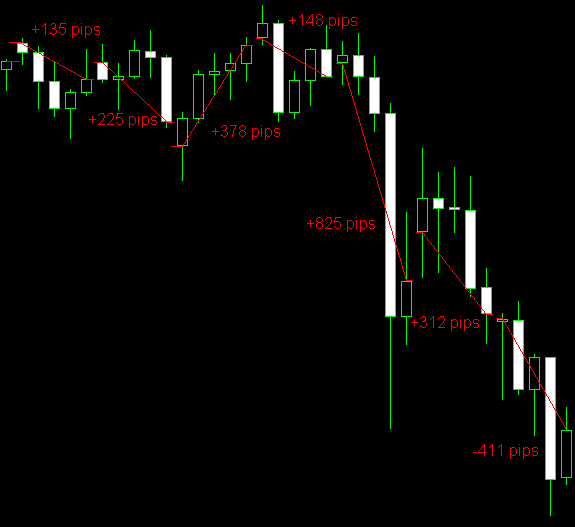

You can see GBP/JPY pair's last 7 weeks (as of May 24, 2010) and all of them have gaps. 6 out of 7 gaps give correct signals that result in a lot of profit. The last gap gives a wrong signal and yields a medium loss. The average spread for GBP/JPY was 3 pips during the example period and all gaps were much wider than 15 pips, making them all qualifying signals. The net total profit was 1,612 pips in 7 weeks — not that bad.

Warning!

Use this strategy at your own risk It's not recommended to use this strategy on the real account without testing it on demo first.

Carry Trade Strategy


Carry Trade strategy — it's one of the most popular fundamental Forex trading strategies. It's used not only by the common retail traders but also by the big hedge funds. The main principle of the carry trade strategies is to buy currency with a high interest rate and sell one with a low interest rate. Such setup offers profit not only from the currency pair's fluctuations but also from the interest rate difference (overnight interest rate). This strategy should only be applied under the normal global economic conditions. You should never use it during the crisis. Remember that your Forex broker should be one of those that actually pay overnight interest rate difference if you want to earn from it. You won't be able to earn from it if your broker is "swap-free".

Features

  • Long-term profit potential.
  • Two sources of profit.
  • Works only with the growing global economy.

How to Trade?

  1. Choose a currency pair with a rather high positive interest rate difference (AUD/JPY, NZD/JPY and GBP/JPY are good historical examples of such pairs).
  2. Go Long or Short on the chosen pair, depending on the direction with the positive overnight interest rate for this pair.
  3. Choose moderate position size, so that it would be able to hold a significant paper loss.
  4. Don't set a stop-loss (one of the few Forex trading strategies, where stop-loss isn't recommended).
  5. Wait.
  6. When you feel that you earned enough or you expect some global financial turmoil, close the position.

Example
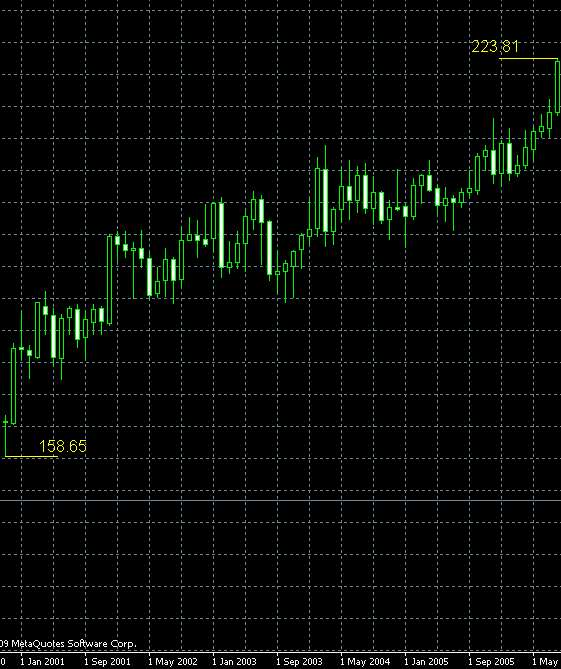
The example chart depicts a long-term "carry trade" growth of GBP/JPY from late 2000 till mid 2006. The pound had an interest rate of about 5% during the period, while the yen had its rate near zero, resulting in an overnight rate of about 5%, which is then multiplied by your leverage. With 1:100 leverage it's approximately 2,500% over the whole period. During the period GBP/JPY also rose by more than 6500 pips. As you see, the profit potential is simply outstanding.

The problem is that the uptrend ended very fast in 2007 and traders had little time to react and close the positions. The carry trade is quite risky and you should be very careful when deciding to use it.

Warning!
Use this strategy at your own risk.It's not recommended to use this strategy on the real account without testing it on demo first.
Forex Strategies


Forex trading can't be consistently profitable without adhering to some Forex strategy. It takes time and effort to build your own Forex trading strategy or to adapt an existing one to your trading needs and style. It's important to choose a strategy or system that is easy to follow with your daily trading schedule and that can be applied successfully with your account balance size. In this Forex strategy repository you'll find various strategies that are divided into three major categories:

  • Indicator Forex Strategies
  • Price Action Forex Strategies
  • Fundamental Forex Strategies

Indicator Forex Strategies are such trading strategies that are based on the standard Forex chart indicators and can be used by anyone who has an access to some charting software (e.g. MetaTrader platform). These Forex strategies are recommended to traders that prefer technical analysis indicators over everything else:


Price Action Forex Strategies are the currency trading strategies that don't use any chart or fundamental indicators but instead are based purely on the price action. These strategies will fit both short-term and long-term traders that don't like the delay of the standard indicators and prefer to listen as the market is speaking. Various candlestick patterns, waves, tick-based strategies, grid and pending position systems — they all fall into this category:


Fundamental Forex Strategies are the based on purely fundamental factors that stand behind the bought and sold currencies. Various fundamental indicators, such as interest rates and macroeconomic statistics, affect the behavior of the Forex market. These strategies are quite popular and will benefit long-term traders that prefer fundamental data analysis over technical factors:


If you want to share your Forex trading strategy with other traders, or want to ask some questions regarding the strategies presented here, please, join a discussion of the Forex strategies at the forum.


Important News Trading Strategy


Important Forex News trading strategy — developed specifically to trade Forex news with as little risk as possible. It can be used only for important Forex news releases such as U.S. GDP, non-farm payrolls and interest rate decisions. Although all currency pairs react on such news, the USD-based currency pairs show the best result.

Features

  • Trades will have fundamental background.
  • Not very hard to set up.
  • High success rate.
  • Important news events are quite rare.
  • High volatility and spread widening during important news releases.

How to Trade?

  1. Choose an important news release that has an effect on the Forex pairs.
  2. For EUR/USD I recommend: U.S. GDP, U.S. nonfarm payrolls, U.S. interest rate decisions, Eurozone interest rate decisions and U.S. budget deficit reports.
  3. Enter both Long and Short positions approximately 30 minutes before the releases (to protect yourself from slippage and ungodly spreads).
  4. Stop-loss for the Long position should be set around the 1-2 hour local minimum.
  5. Stop-loss for the Song position should be set around the 1-2 hour local maximum.
  6. Take-profit for both positions should be set at least to twice the level of stop-loss. I'd recommend even setting it to 3 * SL.
  7. Don't forget to cancel the untriggered orders after the news went out.

Example


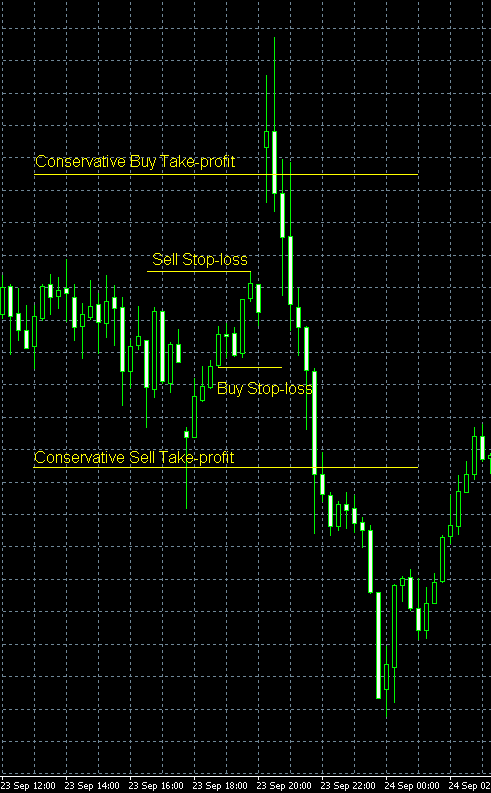
The example chart depicts EUR/USD M15 behavior during the interest rate decision announcement by the FOMC on September 23rd, 2009. Both stop-loss levels are clearly visible in this situation. The conservative take-profit levels are easily hit. Only Long position triggers a TP, while the Short one is closed by SL.

It's possible to trade such news with the pending orders for more potential profit (setting entry points at the same levels as the stop-loss levels are set for the opposite position). But it's more risky.

Warning!

Use this strategy at your own risk. It's not recommended to use this strategy on the real account without testing it on demo first.

Pinbar Trading System


Pinbar Forex Trading System — a popular strategy for entering and exiting positions that is based on the particular candlestick pattern and the following price action. The Pinbar (also known as "Pin-bar" or "Pin bar") pattern was first introduced by Martin Pring in his Pring on Price Patterns.

Features

  • Conservative strategy offers low-risk high-yield opportunities.
  • No-loss rate is pretty high if break-even is applied.
  • Rare occurrence.
  • Timing is critical.
  • Support/resistance is difficult to formalize.

Strategy Set-Up
Any currency pair and timeframe should work, but longer-term timeframes (such as H4, D1 and W1) should work better.

Pinbar Set-Ups:


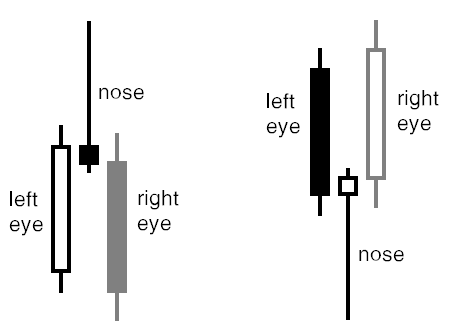
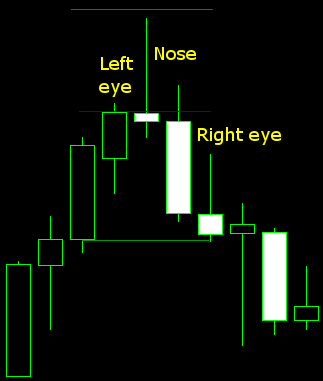
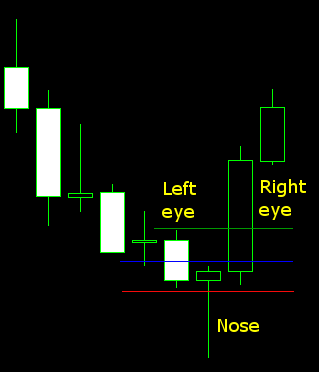
The pattern consists of three bars: the left eye, the nose and the right eye. The left eye should be a bar up for the bearish Pinbar pattern or a bar down for the bullish pattern. The nose bar should open and close inside the left eye, but its high (or low, for the bullish set-up) should protrude much farther than the left eye's high (or low). Both the nose bar's open and close should be located in the bottom (top, for the bullish set-up) 1/4 of the bar. The right eye is where the trading happens.

An additional condition for the good pattern set-up is the strong support/resistance level formed either behind the eyes or near the point of the nose. The stronger are the support/resistance levels you incorporate into this pattern, the more accurate it will be.

You can use the MetaTrader Pinbar Detector indicator to automate the Pinbar pattern detection.

Entry Conditions
Aggressive entry option is to enter a position when in the right eye price retreats behind the left eye's close level.

Conservative entry point is below (above for bullish set-up) the nose bar.

Exit Conditions
Conservative stop-loss can be set behind the nearest support/resistance level behind the eyes. A less conservative approach would be to set stop-loss to immediately behind the nose bar point (in this case, your reward/risk ratio may suffer).

Conservative take-profit can be set immediately after the left eye low (high for the bullish set-up). Aggressive take-profit level may be placed farther — to the next strong support (resistance for bullish positions) level.

Examples
Bearish Pinbar Set-Up:

This is an example of the aggressive set-up. The entry point (blue line) is positioned at the left eye close (price retreated for that entry). Stop-loss (red line) is placed at behind the point of the nose bar (in this situation, even conservative stop-loss wouldn't be hit, as the price pull-back during the right eye happened before the entry). Take-profit (green line) is set at the nearby support level and is easily filled.


Bullish Pinbar Set-Up:

This is an example of the conservative set-up. The entry point (blue line) is placed just behind the nose bar. Stop-loss (red line) is below the left eye. Take-profit (green line) is just above the left eye.

Warning!

Use this strategy at your own risk. It's not recommended to use this strategy on the real account without testing it on demo first.


Get Paid To Promote, Get Paid To Popup, Get Paid Display Banner