The most common mistake made by people who attempt to put together their first resume is that they put in too much information. They want to describe everything that they have ever done from the moment of conception to the present. The resume ends up being too long, and nobody will read it.

Monday, March 19, 2012

Lupin III-The Castle of Cagliostro


Kanjiルパン三世 カリオストロの城
RōmajiRupan Sansei: Kariosutoro no Shiro
Directed byHayao Miyazaki
Produced byTetsuo Katayama
Screenplay byHaruya Yamazaki
Hayao Miyazaki
Based onLupin III by
Monkey Punch
StarringYasuo Yamada
Kiyoshi Kobayashi
Makio Inoue
Eiko Masuyama
Goro Naya
Sumi Shimamoto
Tarō Ishida
Music byYuji Ohno
CinematographyHirokata Takahashi
Editing byMitsutoshi Tsurubuchi
StudioTokyo Movie Shinsha
Topcraft
Distributed byToho
Release date(s)December 15, 1979
Running time100 minutes
CountryJapan
LanguageJapanese

Pom Poko


Directed byIsao Takahata
Produced byToshio Suzuki
Yasuyoshi Tokuma
Hayao Miyazaki
Screenplay byIsao Takahata
Story byHayao Miyazaki
StarringKokontei Shinchou
Makoto Nonomura
Yuriko Ishida
Editing byTakeshi Seyama
StudioStudio Ghibli
Distributed byToho
Release date(s)July 16, 1994
Running time119 minutes
CountryJapan
LanguageJapanese
Pom Poko (平成狸合戦ぽんぽこ Heisei Tanuki Gassen Ponpoko?) As civilisation draws ever nearer to their idyllic forest home, a group of mischievous Japanese tanuki (raccoon dogs - Nyctereutes procyonoides) try to scare humans away. But they soon discover that humans are not their only rivals in the struggle for their age-old territory.

Released in 1994 as the Japanese economy slumped, but looking back to the sixties construction boom in Tokyo’s Tama Hills, Pom Poko questions the money-grabbing ethics of yuppie Japan, and mourns the loss of the countryside. Drawing on Japanese myths and legends, writer and director Isao Takahata presents a satirical view of woodland spirits using every available magical ruse to take on modern developers: including transformations, sabotage and trickery.

Pom Poko is a unique window into Japanese folklore, a comedy of modern failings, and an elegiac tale of unlikely heroes fighting insurmountable odds.

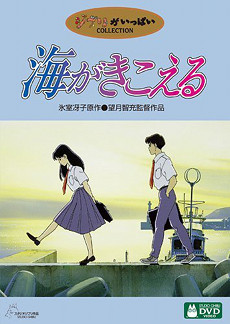
Ocean Waves (film)

海がきこえる
(Umi ga Kikoeru)
GenreDrama, Romance, School life
Novel
Written bySaeko Himuro
Illustrated byKatsuya Kondō
Published byTokuma Shoten
Published1993
TV film anime
Directed byTomomi Mochizuki
Produced byIsao Takahata
Hideo Ogata
Music byShigeru Nagata
StudioStudio Ghibli
Licensed byUnited Kingdom Optimum Releasing
NetworkNTV
ReleasedMay 5, 1993
Runtime72 minutes
Novel
I Can Hear the Sea II: Because There Is Love
Written bySaeko Himuro
Illustrated byKatsuya Kondō
Published byTokuma Shoten
Published1995
Ocean Waves (海がきこえる Umi ga Kikoeru?) is the official English title (from Japan) for a film more commonly known as I Can Hear the Sea (the literal meaning of the Japanese title). Set in Kochi (on the island of Shikoku), Umi tells the story of a love triangle that develops between two good friends and the new girl in school who transferred from Tokyo. The new girl, Rikako, is at first arrogant and distant, but eventually makes friends.

Porco Rosso

Directed byHayao Miyazaki
Produced byToshio Suzuki
Written byHayao Miyazaki
StarringShūichirō Moriyama
Tokiko Kato
Akemi Okamura
Akio Ōtsuka
Music byJoe Hisaishi
CinematographyAtsushi Okui
Editing byTakeshi Seyama
Hayao Miyazaki
Distributed byToho (Japan)
Walt Disney Pictures(US)
Release date(s)July 18, 1992
Running time94 minutes
CountryJapan
LanguageJapanese


Porco Rosso (紅の豚 Kurenai no Buta?, literally "The Crimson Pig") was first planned as a 30-45 minutes in-flight movie on Japan Airlines. It's been described as "a movie which tired businessmen on international flights can enjoy even with their minds dulled due to lack of oxygen." As Miyazaki's imagination took off, it became a feature-length movie about an Italian Air Force pilot who left the service due to the rise of fascism. He became a bounty hunter, assuming the name "Porco Rosso."

Soundtrack

  1. "The Wind of Time (When a Human Can Be a Human)" – 2:50
  2. "MAMMAIUTO" – 1:21
  3. "Addio!" – 0:37
  4. "The Bygone Days" – 2:16
  5. "A Sepia-Coloured Picture" – 0:47
  6. "Serbia March" – 1:03
  7. "Flying Boatmen" – 2:36
  8. "Doom (Cloud Trap)" – 1:23
  9. "Porco e Bella" – 1:06
  10. "Fio-Seventeen" – 2:04
  11. "The Women of Piccolo" – 2:04
  12. "Friend" – 3:04
  13. "Partnership" – 2:28
  14. "Madness (Flight)" – 2:39
  15. "To the Adriatic Sea" – 1:50
  16. "In Search of the Distant Era" – 2:18
  17. "Love at First Sight in the Wildness" – 1:11
  18. "At the End of Summer" – 1:26
  19. "Lost Spirit" – 4:11
  20. "Dog Fight" – 2:10
  21. "Porco e Bella (Ending)" – 2:35
  22. "The Time of Cherries" (sung by Tokiko Kato) – 2:52
  23. "Once in a While, Talk of the Old Days" (composition, lyrics, singing by Tokiko Kato, arrangement by Yoko Kanno, Junichiro Ohkuchi) – 3:56

Sunday, March 18, 2012

Laputa-Castle in the Sky


Kanji天空の城ラピュタ
RōmajiTenkū no Shiro Rapyuta
Directed byHayao Miyazaki
Produced byIsao Takahata
Written byHayao Miyazaki
StarringKeiko Yokozawa
Mayumi Tanaka
Kotoe Hatsui
Minori Terada
Music byJoe Hisaishi
CinematographyHirokata Takahashi
Editing byHayao Miyazaki
Takeshi Seyama
Yoshihiro Kasahara
StudioStudio Ghibli
Distributed byToei Company
Release date(s)August 2, 1986
Running time126 minutes
CountryJapan
LanguageJapanese
Laputa: Castle in the Sky (天空の城ラピュタ Tenkū no Shiro Rapyuta?) is an adventure movie. Pazu rescues an unconscious girl descending from the night sky with a glowing pendant around her neck. He helps the girl, Sheeta, to escape from the air pirates and the military who are obsessed with Laputa, a legendary kingdom on a floating island in the sky with which Sheeta is suspected of being connected.

With an adventurous boy as the main character, Miyazaki tells "a story that involves discoveries and wonderful encounters...a story that carries a message of hope." The production of Laputa also led to the establishment of Studio Ghibli in 1985.

Initially, this film had a brief theatrical screening in America in 1989. Since then, Disney has brought the film to the United States and to the rest of the world with a soundtrack freshly rescored by Joe Hisaishi, who composed the original, and performed by a full symphony orchestra.

Soundtrack and Download


Download links for movie
Get Paid To Promote, Get Paid To Popup, Get Paid Display Banner